Monday, November 30, 2015

Record Sales for Town & Country Garden Club 'Awesome Auction'


The Town & Country Garden Club annual Awesome Auction set a record in sales!
Gross earnings topped the 2014 Auction by 50 percent and attendance was up
 23 percent. The garden club uses its Awesome Auction proceeds to support
Durham non-profits including the Museum of Life and Science,
Duke Homecare & Hospice, and Community Life and Recreation Center.
Photos by Robin Marin, T&C GC President.

Tuesday, November 24, 2015

Garden Spotlight: The Vegetable Garden of Monticello


The Vegetable Garden Today

The recreation of the Monticello vegetable garden began in 1979 with two years of archaeological excavations that attempted to confirm details of the documentary evidence. Archaeologists uncovered the remnants of the stone wall, robbed in the twentieth century and covered by eroding soil, exposed the foundation of the garden pavilion, and searched for the nature of garden walkways. The ensuing recreation is especially accurate in detailing the structure of the garden -- the location of the garden squares, the site and character of the wall, and the appearance of the garden pavilion.

The garden recreation attempts to show, as best as possible, the garden as it existed between 1807 and 1814, to reveal Jefferson's experiments in horticulture and landscaping, and to serve as a site for the collection of both Jefferson and nineteenth-century vegetable varieties. The garden today, however, is only an interpretation of the original. Modern tools, such as roto-tillers, are utilized to ease the maintenance of the garden. Organic fertilizers, natural pesticides, and irrigation are used to preserve the varietal collection. Nineteenth-century techniques -- the use of brush for the staking of peas (shown at right), the manuring of perennial vegetables, the construction of composted hills for squashes, melons, and beans -- are utilized when appropriate.

There are a number of differences between the appearance of the original Jefferson garden and the recreated one. In 1811, the most intensive planting year for Jefferson, there were eighty-five plantings of vegetables throughout the year. Today, the garden is planted much more intensively, partly for seed collection, partly to present a fuller interpretive picture. The rows of vegetables Jefferson planted were much closer together than they are portrayed today, the wider spacing a maintenance necessity. Although Jefferson alluded to the "long, grass walk," the nature of the internal pathways -- whether turf, gravel, tan bark, or more likely, packed earth -- is a matter of conjecture. The low locust railing along the edge of the garden serves as a safety barrier. It is possible, however, to replant many of the perennials in the precise locations that Jefferson had specified. The figs along the Submural Beds, the cherry trees along the long grass walk, and the asparagus and artichoke squares conform precisely to their locations in the original garden. Also, many of the varieties Jefferson especially treasured, from the Marseilles fig to the Chile strawberry to the Tennis-ball lettuce, have been replanted in today's garden.


The Site of the Vegetable Garden

The vegetable garden evolved over many years, beginning in 1770 when crops were first cultivated along the contours of the slope. Terracing was introduced in 1806, and by 1812, gardening activity was at its peak. The 1,000-foot-long terrace, or garden plateau, was literally hewed from the side of the mountain with slave labor, and it was supported by a massive stone wall that stood over twelve feet in its highest section. One contemporary visitor remarked on the dramatic "sea view" across the rolling Piedmont countryside.

Perched atop the wall, at the half-way point of the garden, is the garden pavilion with its double-sash windows, Chinese railing, and pyramidal roof. The pavilion was used by Jefferson as a quiet retreat where he could read in the evening. It was reputedly blown down in a violent wind storm in the late 1820's. The pavilion was reconstructed in 1984 based on Jefferson's notes and archaeological excavations. It overlooks an eight-acre orchard of 300 trees, a vineyard, and Monticello's berry squares, which are plots of figs, currants, gooseberries, and raspberries.

Thomas Jefferson was an astute observer of the natural world. The daily activities of sowing seeds, manuring asparagus, and harvesting peas between 1809 and 1826 are precisely recorded in his "Garden Kalendar," a part of his famous Garden Book. Jefferson was often the detached scientist in the Kalendar as he recorded that his Hotspur peas were "killed by frost Oct. 23," or that his yellow squash "came to nothing" in 1809. He could also record remarkable detail as in 1811 when he noted of his Asparagus beans that "2/3 pint sow a large square, rows 2 1/2 feet apart and 1 f. and 18 I. apart in the row, one half at each distance."

For Jefferson, the vegetable garden was a kind of laboratory where he could experiment with imported squashes and broccoli from Italy, beans and salsify collected by the  
Lewis and Clark expedition, figs from France, and peppers from Mexico. Although he would grow as many as twenty varieties of bean and fifteen types of English pea, his use of the scientific method selectively eliminated inferior types: "I am curious to select one or two of the best species or variety of every garden vegetable, and to reject all others from the garden to avoid the dangers of mixing or degeneracy."

Jefferson the Gardener


Although the garden was essentially a functional part of the plantation, Jefferson occasionally considered other ornamental features aside from the garden pavilion. He discussed planting an arbor of different flowering shades of the scarlet runner bean (shown at left), arranged adjacent rows of purple, white, and green sprouting broccoli, or even white and purple eggplant, and he bordered his tomato square with sesame or okra, a rather unusual juxtaposition of plant textures. Cherry trees were also planted along the "long, grass walk" of the garden to provide shade.

"I have lived temperately, eating little animal food, and that . . . as a condiment for the vegetables, which constitute my principal diet."


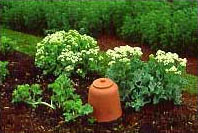
Salads were an important part of Jefferson's diet. He would note the planting of lettuce and radishes every two weeks through the growing season, grow interesting greens such as orach, corn salad, endive, and nasturtiums, and yearly plant sesame in order to manufacture a palatable salad oil. Although the English pea is considered his favorite vegetable, he also cherished figs, asparagus, French artichokes, and such "new" vegetables as tomatoes, eggplant, broccoli, and cauliflower. While Jefferson cultivated more common vegetables such as cucumbers, beans (both "snaps" for fresh use and "haricots" that were dried), and cabbages, he also prized his sea kale (Crambe maritima, shown above right), a perennial cabbage-like vegetable whose spring sprouts were blanched with clay pots, then cut and prepared like asparagus."

19th-Century Vegetables and Cultivation Techniques

The character of garden vegetables has been altered since the early 1800's due to the technology of commercial production, the tastes of the consumer public, and even the function of the vegetable itself. Some of the variations that distinguish modern varieties from their nineteenth-century parents include insect and disease resistance, a fruit suitable for shipping, compact plants, more consistent harvesting dates, and more cosmetically pleasing fruits.

Most vegetable species are annuals and thus are lost easily if seed collection is neglected. Names have been changed for commercial purposes. Jefferson often listed varieties according to the person from whom he received the seed ("Leitch's pea"), its place of origin ("Tuscan bean"), or else he noted a physical characteristic such as color ("yellow carrot") or season of harvest ("Forward pea"). "Leitch's pea" is not only unavailable from commercial sources today, but there is no description of its qualities in the garden literature of the last two centuries. The collection of Jefferson's 250 vegetable varieties is a complex challenge. In many cases, the varieties planted in the garden today were known in the nineteenth century, and serve as substitutes for the originals grown by Jefferson.

Cultivation Techniques


A major influence on Jefferson's gardening practices was Bernard McMahon, a Philadelphia nurseryman and author of The American Gardener's Calendar, the most complete American work on horticulture in the first half of the nineteenth century. McMahon's book provides directions for manuring the garden, interplanting lettuce and radishes, cultivating unusual vegetables such as tomatoes and sea kale, and planting cucumbers in hogsheads. These practices were duplicated carefully in the garden at Monticello. McMahon also sent Jefferson important vegetable varieties such as the Leadman's Dwarf pea, the Egyptian onion, Early York and Sugarloaf cabbage, red celery, and red globe artichoke.

In 1793,
Martha Randolph wrote her father from Monticello and complained of insect damage in the garden. Jefferson's response summarized a basic philosophy of gardening:

"We will try this winter to cover our garden with a heavy coating of manure. When earth is rich it bids defiance to droughts, yields in abundance, and of the best quality. I suspect that the insects which have harassed you have been encouraged by the feebleness of your plants; and that has been produced by the lean state of the soil. We will attack them another year with joint efforts."

How much manure Jefferson spread himself is a matter of speculation; however, in his daily attention to details in the garden as evidenced by the "Garden Kalendar" suggests that he was at hand, perhaps directing the work. Jefferson's slave
Isaac recalled that "For amusement he [Jefferson] would work sometimes in the garden for half an hour in right good earnest in the cool of the evening."

https://www.monticello.org/site/house-and-gardens/vegetable-garden

Thursday, November 19, 2015

Winterizing the Herb Garden (and Other Perennials)

Witherspoon Rose Culture President David Pike recently presented an educational program regarding winterizing roses and the garden to the Forest Hills Garden Club. Mr. Pike warned of the hard freeze forecasted for Monday, Nov. 23, and said that now is the time to cutback perennials like Lantana. Mulch roses and all plants soon after Monday when they have gone dormant. 


IF TREATED PROPERLY, many herb plants will survive in the garden for a number of years. Others are sensitive to frost or severe cold weather and must be brought indoors, protected, or replanted each year. Annual herbs will be killed with the first hard frost in the fall. Remove dead plants in order to minimize overwintering insects and disease problems. Some frost sensitive herbs, such as basil and geranium, can be brought indoors for the winter. Take cuttings to root or pot the entire plant.Many perennial herbs are winter hardy in all or parts of North Carolina and can be left in the garden. A few plants are marginally winter hardy; in a mild winter they survive but may die during a severe winter. They can be brought indoors to overwinter. Unless they receive adequate light indoors they may drop some of their leaves. Lemon verbena is a deciduous plant; it will lose all of its leaves indoors.

After a severe winter, some outdoor plants such as rue, sage, thyme, and southernwood, may appear brown and dead. The leaves may simply be dehydrated or the plant may be dead almost to the ground. Scrape the bark of a few stems to determine the extent of damage. If the stem is green, delay pruning until after new growth begins. 

Improving Winter Survival

Most herbs benefit from a 2-3-inch layer of organic mulch (pine straw, coco bean hulls, hardwood bark, bark and sawdust mixture) during the growing season. Mulch is an adequate winter protection for herbs such as mint, chives, and fennel providing protection to minus 20°F. A winter mulch helps maintain uniform soil temperatures around the root system and provides protection against heaving cause by frequent freezing and thawing of the soil.

Some herbs require a thicker layer of mulch to protect their roots during extended freezing weather. Heavy mulching before cold weather occurs should be avoided since it will keep the soil warmer and may actually decrease winter hardiness. After the first hard freeze, apply a 3-6-inch layer of organic material such as straw, pine needles, or chopped leaves. Most of the mulch should be removed in the spring as new growth begins.

Rosemary, lemon verbena, and a few other perennial herbs are not reliably winter hardy. Extra winter protection can be provided by cutting plants back to within a couple inches of the ground after the first hard frost and covering the remaining stub with soil. Then cover the soil with a 4-5-inch layer of mulch. For lemon verbena, the use of a microfoam ground cover (the packing material used around fragile items) also works held down with soil works very well providing over 95% survival in most years. An alternative method is to encircle the plant with a cage of hardware cloth or chicken wire. The cage diameter should be about 12 inches larger than the plant (6 inches on each side). Fill the cage with mulch.

Harsh, drying winds can prove as fatal as cold temperatures to some of the less cold tolerant herbs. Wind breaks can aid the survival and appearance of herbs such as French tarragon, germander, English lavender, Roman chamomile, and winter savory. Covering with a few evergreen boughs will prevent drying out of silver and lemon thyme foliage. The more cold-sensitive herbs have a better chance of survival if grown in a protected location.

Other cultural practices that influence winter hardiness include: fertilization, pruning, soil drainage, and watering.


Fertilizing
Herbs should not be fertilized after early August. Late summer applications of nitrogen fertilizer will promote new growth that may not have time to mature before frost. The herbs will remain actively growing instead of becoming acclimated for cold weather.

Pruning
Avoid significant pruning (light harvesting is acceptable) in August which will stimulate new growth that will not have time to mature before frost. Also, avoid severe pruning in late fall since winter hardiness is reduced until the cuts have healed. Woody plants should not be severely pruned within 4 to 6 weeks of the first severe freeze. In western North Carolina, the last severe cutting on sage, lavender, or oregano should be made before early September. Light pruning after frost is acceptable.

Soil Drainage
Excessively wet soil or sites with standing water can decrease winter hardiness of some plants. This is especially true for Mediterranean plants such as rosemary, thymes, lavenders, and French tarragon that are adapted to dry climates. Provide adequate drainage by incorporating pine bark mulch or planting in raised beds.

Watering
Keep plants adequately watered during late summer and fall. Drought stressed plants are weaker and are often less cold hardy. Water during a dry winter, especially before a severe freeze. This is especially true for evergreen plants that will lose water from their foliage on bright, sunny days even when the ground is frozen.

For Further Reading
HIL-8110 -
Growing Herbs for the Home Gardener
HIL-8111 -
Harvesting and Preserving Herbs for the Home Gardener

Authors:
Linda Blue, Extension Agent, Agriculture - Urban Horticulture
Buncombe County
Jeanine Davis, Extension Specialist, Herbs/Organics/Specialty Crops/Vegetables
Horticultural Science
Ervin Evans, Extension Associate (Consumer Horticulture)
Horticultural Science 

Publication date: Jan. 31, 1999

Monday, November 16, 2015

Holiday Lights at the Elizabethan Gardens: November thru January

Join The Elizabethan Gardens and Southern Bank for the opening celebration of WinterLights, a spectacular twenty-two night event of holiday lights and sights. Opening is Friday, Nov 27, 2015, 6-9:00 p.m.
 
Find holiday warmth and charm inside and out with festive food and drink in the “Embellished” Hall, and cozy fire pits on the Great Lawn as well as seasonal gift shop and plant sales. 
 
The Holiday Lights will be open to the public:
  • December 2-5, 9-12, 16-19, 23, 26,30 (Wednesdays thru Saturdays) 
  • January 2,8,9,15,16,22,23 (Fridays and Saturdays) from 6pm-9pm.
Non-Members: Adults $15, Youth (ages 6-17) $9, Youth (5 and under) $7. Members/Friends: Adults $11, Youth (ages 6-17) $8, Youth (5 and under) $6. For info or details, call 252-473-3234252-473-3234 or visit www.elizabethangardens.org.